The Myths of Sustainability Relative to Beef Production…

cabstripsteakI really love to eat beef!

I really love to eat beef, and it is important to me that I feel good about my food choices.  Because I care about the environment and the sustainability of our earth, I strive to raise beef responsibly.  At the end of the day, I want to feel good about both how I spent my day raising cattle and also about the beef that I place on the dinner table for my family to eat.

This is a good way to end the day...

This is a good way to end the day…

There are many myths regarding the topic of sustainability and beef production.  I asked Dr. Stackhouse-Lawson to address a few of these in the hopes that it will enable us all to have a clearer picture of the “sustainability of our beef”.

Anne: What are the top 3 myths that you hear about related to sustainability and the beef production chain?

Kim: 1) Grass fed or organic is more sustainable than conventionally-raised beef. This is simply not true. When it comes to measuring sustainability, more efficient utilization of resources like land and water is the most important thing. I am not advocating that consumers should not eat grass fed or organic beef or that they should choose conventional beef. The great thing about food is that in America, we have a choice – but if you are choosing one production method because you believe one production practice is more sustainable than another, you are misinformed.

2) Eating less beef improves your individual sustainability. Beef producers have reduced their environmental burden by 9 percent in five years. Cattlemen and cattlewomen are already working toward a more sustainable future and beef is necessary to provide protein to a growing global population. In fact, every agriculture product will be necessary as we work to provide food for more than 9 billion people with a balanced diet without depleting our natural resources. Furthermore, many cattle ranchers are located on land that cannot be utilized for crop production and cattle do a great job converting forage that is otherwise unusable by humans to a nutrient dense protein.

3) All of the environmental impact of food occurs on the farm – Actually, in many of the sustainability impact categories we measured, such as energy use, the consumer and retailer use more energy than the farmers. This illustrates why it is so important to evaluate sustainability across the entire supply chain – so that improvements can be made where they actually make a difference.

Feel good about what you cook.  Megan does :)

Understanding where your food comes from helps you to feel good about what you cook. Just ask Megan  :)

4 Comments

Filed under General, Sustainable Spring

Sustainability Q and A with Dr. Kim Stackhouse-Lawson

It is my job to care for him in the best way, and also using the fewest natural resources...

It is my job to provide him with good care, and also to use the fewest natural resources to grow nutritious beef…

Matt and I care about the sustainability of our farm.  We not only want it to endure, but to thrive.  Our goal is to produce high quality products through the judicious use of natural resources.  In our journey to continuously improve, we look to scientists like Dr. Stackhouse-Lawson for guidance.

Below is a Q and A with Dr. Kim where she answers my biggest questions relative to the topic of sustainability.

Anne: Why do you think that it is important for beef farmers and ranchers to understand issues related to sustainability in beef production?

Kim: The largest challenge that agriculture is faced with today is preparing to feed a growing population which is expected to surpass 9 billion people by 2050. This population will require at least 70% more food using fewer resources than we have today.   Beef producers have a rich heritage of passing ranches and feed yards from generation to generation, however, sustainability is more than that.  With the increasing pressure of producing more food with limited resources, it is more important than ever before to utilize research and science to help meet this challenge.

For this reason, the beef checkoff has funded the largest sustainability assessment ever conducted along a food supply chain.  This study will ensure that U.S. beef producers will have the knowledge to continue to produce high quality beef while increasing our stewardship of land and resources.

Anne: Why is it important to have scientific documentation of the environmental footprint of beef?

Kim: It is important to have scientific documentation about our industry’s sustainability so that farmers can better utilize new innovations.  It is also imperative that the beef industry be able to measure improvements. One of the real challenges with sustainability is that 100 people will have a hundred different definitions.

The beef industry’s definition is much larger than the traditional definition of just carbon footprint or measuring greenhouse gas emissions. To the beef industry, sustainability is about balancing environmental responsibility, economic opportunity, and social diligence.

Anne: Explain the scope of the beef sustainability study, as well as the initial findings.  What are we doing well, and what do we need to work on?

Kim:  We used a life cycle assessment to predict environmental, economic, and social impacts to benchmark the sustainability of U.S. beef in the past and present. Millions of data points were utilized to accurately capture all inputs and outputs along the beef value chain. Comparing sustainability over time allows us to understand how improvements in cattle management and changes in technology affect industry sustainability.

Since 2005 the sustainability of beef has improved significantly.  Some examples of why U.S. beef industry sustainability has improved include: Improvements in crop yields, animal performance, and the increased utilization of bio-gas recovery.

This life cycle assessment method also allows us to identify areas where opportunities for improvement exist; some examples include: improving cattle utilization of protein in their diets, reducing packaging material, and reducing food waste.

Anne: What is the next step after the results are validated?

Kim: We are expanding the work to regionalize the data, so farmers can utilize the results to analyze their operation, regardless of where they raise cattle. This is a very important aspect of our sustainability project because a one-size-fits-all approach is not sustainable.

Different areas of the country have different resources available, and every producer faces a variety of challenges based on where they live and the climate they face. We are also working to develop a tool that will allow producers to assess individual approaches to improving sustainability on their farm.

beef sustainability image

Leave a Comment

Filed under General, Sustainable Spring

Women and Sustainability…

As the mother of three girls, I am always looking for strong female role models to mentor my girls.  One of my goals as a parent is to raise my daughters to be strong, confident, and motivated women.  I want them to embrace life with a passion and use their talents to make the world a better place.

a

Many opportunities—Many dreams…

When I became a part of the beef family in 1997, I was challenged as a young woman trying to gain respect in a man’s world.  In particular at that time, the cattle feeding (feedyard) part of the beef family was made up predominately of men.

Over the years, I have watched the dynamics change with more and more young women choosing a life raising beef cattle.  In addition to a growing number of female beef farmers, there are also a growing number of women scientists that serve as professional consultants: helping farmers like me to make good decisions regarding animal care and environmental stewardship.

I believe that a diverse mix of men and women makes a stronger beef family.  This more eclectic group allows for a wider array of perspective and savvy.  I have no idea if any of my three girls will choose a life in agriculture, but I want them to realize that if they work hard then opportunities await them.

Kim

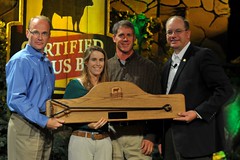
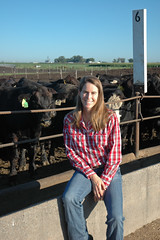
Dr. Kim Stackhouse-Lawson

One of the young women that I want my daughters to meet is Dr. Kim Stackhouse-Lawson, Ph.D. Kim is the Director of Sustainability Research for the National Cattlemen’s Beef Association.  A native of Northern California, she grew up in a small ranching community where her family raised ewes and beef cattle.

In addition to participating in FFA and playing an active role on the ranch, Kim was an all-state downhill skier and basketball player while also being an acclaimed horsewoman.  She still actively competes in dressage riding as well as being a rising star in the discussion of sustainability relative to beef production.

Kim and Day Lilly...

Kim and Day Lilly…

While Kim can claim many great accomplishments, I believe that her greatest talent is her proactive passion for environmental stewardship.  Her childhood memories of town hall meetings marked by heated discussions regarding public land use inspired her to become a woman who uses science to ensure the judicious use of natural resources.

Her quiet confidence and innate personal integrity have gained my respect, and I look to her for guidance as I work to reduce the environmental footprint of my farm.  Her work on Beef Sustainability Research gives me faith for the future.

The ranch where Kim grew up in Northern California.  Her love of this land motivates her as a scientist every day.

The ranch where Kim grew up in Northern California. Her love of this land motivates her as a scientist every day.

Kim is currently working with the BASF Corporation North America (a world leader in conducting comprehensive life cycle analyses) and the Agricultural Research Service of the USDA to create the first industry-wide beef sustainability assessment.  This assessment will examine the sustainability of the entire beef supply chain from pasture to plate.

I am very thankful that Kim has agreed to enter our discussion of sustainability and she will be a contributor to the next couple of Feed Yard Foodie posts.  Not only will we all benefit from Kim’s knowledge and level-headed savvy, but my girls will get to be “introduced” to her as well.  This will be great preparation for the day where they can meet Kim in person as she is at the top of the list for possible mentors!

2 Comments

Filed under General, Sustainable Spring

Rural Communities: What allows them to endure?

I asked my favorite teenager recently what she thought made our small community both special and sustainable.  I found her list particularly interesting and pertinent relative to our Sustainable Spring discussion.

The Cozad Junior High athletes that competed last weekend in the State track meet.  My favorite teenager kneeling in the front row in the red shirt.

The Cozad Junior High athletes that competed last weekend in the State track meet. My favorite teenager is kneeling in the front row in the red shirt.

  1. Pride in community
  2. Caring nature of community members
  3. Self-reliant
  4. Underlying toughness
  5. Athletic and extracurricular activities universally available to all interested youth
  6. United community in one school system

A key component to our farm’s sustainability is the ability of our rural community to endure.  Our community of Cozad not only provides Matt and I with the services that we need for our agricultural businesses, but it also plays a key role in helping us to raise our children.

Hometown pride...

Hometown pride…

An elementary school teacher in our town told me a few years ago, “Anne, it takes an entire community to raise a child”.  As I think of the thousands of children that I have coached and the hundreds of other adults that have mentored my own children, I realize how very true this statement is.

I was not born in rural America, but I have become a believer in the core values that permeate life in our small town.  The pace is a little bit slower, the people are a little bit friendlier, and an underlying goal of community prosperity dictates an element of teamwork that I never saw growing up in urban America.

  • I live in a community where class distinctions are blurry and hometown pride prevails.
  • I live in a community that unites together to endure challenges, looking inward to find the faith and the strength needed to persevere.
  • I live in a community where youth are universally included in activities and encouraged to participate.
  • I live in a community where every child attends school together, and education is a community project.

    A special thanks to Katie Arndt for taking this picture.

    A special thanks to Katie Arndt for taking this picture.

Matt and I feel blessed to be a part of such a wonderful community, and we try our best to give back to the town that has given us a quality of life that is second to none.

Matt volunteers as a member of the town hospital board, the Cozad Development Corporation, the United Way investment committee, and several other agriculturally related area groups.  I focus my efforts outside of agriculture on youth athletic programs and have spent this spring coaching and helping with three different sports teams (soccer, swimming and track).

Perhaps this YouTube video describes the community feeling that permeates rural America’s small towns most effectively.  Take a moment to watch the Cornhusker Football team with a young boy challenged with cancer and you will see the heart of America—the vital presence of a compassion that creates an inherent ability to endure.

This is the essence of rural America: strong, compassionate and sustainable…

2 Comments

Filed under General, Sustainable Spring

Why Blog?

I read a blog post this week that spoke to me so much that I am going to deviate from my Sustainable Spring series to tell you all about it.   The author of the post is Aimee Whetstine who blogs at everyday epistle.

a

Aimee

Aimee was one of my very first “virtual friends”.  Although I have never met her in person, I value the relationship that we have built over the past year and a half.  I faithfully read her words each week because she respectfully inspires me to think even when we look at issues from different perspectives.

You can read Aimee’s post at http://projectunderblog.com/debunking-8-rules-of-blogging/ or visit her at http://everydayepistle.com/.

This week, Aimee tackled the issue of “Why Blog”, and what rules a blogger should live by.  It took me back to the weeks preceding my leap into social media in the spring of 2011, and also inspired me to rethink my current goals.

He is a silent contributor, but I could not do it without him...

We’re in this together…

Aimee did this with two short pieces of excellent advice:

  • Publish when you have something to say.
  • Your blog is a reflection of what matters to you.

I began blogging because I had something to say.  I wanted to open up my farm in an effort to have a respectful conversation about how I care for cattle and raise beef in a feed yard.   I believe in transparency and I believe that every consumer has a right to know how their food is raised.

I've become a farm girl and the days that I spend in the processing barn "working cattle" are some of my favorites...

Over the past 16 years I’ve become a farm girl, and the days that I spend in the processing barn “working cattle” are some of my favorites…

I continue to blog because I love to write.  I am a naturally reserved person, but I have found that I love to share my life through pictures and the written word.  From the challenges that I face — to the joys of raising my daughters in rural America, blogging is truly a personal journey that brings me joy.

Because I am not good at separating my life between raising cattle, parenting my girls, and sharing our story; my blog is a reflection of what matters to me.  It is a voluntary “labor of love”, and one that I am very proud of.  While it is sometimes easy to get caught up in the social media hype of blog statistics, I believe that blogging is truly about sharing, conversation, and personal growth.

There are many different types of conversations, but they must all be based on respect...

Conversations come in many types, but they must all be based on respect…

There may be times in the future that I *temporarily* may not have anything to say (my favorite teenager would like to go on record here to say that she doubts it!); but I will always come back because Feed Yard Foodie is an extension of me—a creative and intellectual outlet for the Ivy League educated psychologist turned cattle caregiver.

They are not just a number, they are an animal that deserves to receive good care and will give its life to nourish my children...

They are not just a number, they are animals that deserve to receive good care and will give their lives to nourish many very special people…

Hat’s off to Aimee and the countless other people that inspire me daily to be the best that I can be.  Thank you for respecting the individual that I am, and for choosing to join me in my adventures.

Perfection is not attainable, but if we chase perfection we can catch excellence.

Vince Lombardi

13 Comments

Filed under Foodie Work!, General

Digging In the Dirt…

I have always loved digging in the dirt.  Although I grew up in the city, my dad is an avid hunter and we spent many of my childhood weekends in the Lake Okeechobee area hunting on Florida ranch land for quail, ducks and dove.

My brother and I, many many years ago out at the "hunting camp"...

My brother and I, many many years ago out at the “hunting camp”…

When Matt and I moved to Nebraska, my one condition on the move was that I wanted a house “in the country” where I could have lots of room to have animals and gardens.  Our house is positioned on the edge of one of Matt’s farms and sits on about five acres.

My two horses lay claim to a large portion of those acres, but I still have plenty of room to experiment and grow things.  This spring has been mentally challenging for me because it has been too cold to garden.  Our trees are only now starting to bud and my summer perennials are barely peaking their brave heads above ground (the tulips and daffodils perished in a snow storm several weeks ago).  My fingers have been itching to play in the dirt…DSC05280

On Sunday, we had temperatures in the low sixties so I herded up my free labor and headed outdoors to do some gardening chores.  My girls always complain a little bit as we get started, but it does not take long for my older ones to get excited about transplanting and clearing out the flower gardens.

Transplanting lilies...

Transplanting lilies…

They seem to have inherited my love for digging in the dirt and making things grow…

In addition to my perennial flowers taking the plunge above the soil, my rhubarb and asparagus are coming up.  It will not be long before it is time to get the colder season annual vegetables in (it was 28 degrees Saturday morning so not quite yet!).  This year we are doing a combination vegetable garden with my  mother-in-law and the girls are in charge of weeding :)

Dividing our Irises...

Dividing out and replanting Irises…

It renews my soul to dig in the dirt.  It fuels my optimism to watch new life grow in my gardens.  It brings a smile to my face to watch my daughters learn the combination of care and just a little magic which brings beauty to our yard and vegetables to our table.

Even while we garden and water, she still dreams about that great tasting steak that will go along with her vegetables :)

Even while we garden and water, she still dreams about that great tasting steak that will go along with her vegetables :)

We topped off the afternoon by finding the first toad of the year.  Karyn seemed to spend more time playing with it than helping with the gardens...I guess that is the joy of being the baby of the family!

We topped off the afternoon by finding the first toad of the year. Karyn seemed to spend more time playing with it than helping with the gardens…I guess that is the joy of being the baby of the family!

Is it warm enough to get your gardens going for the growing season?

5 Comments

Filed under Family, General, Sustainable Spring

BlogHer Feature…

BlogHerBadgeYesterday afternoon, BlogHer featured a version of “Different Kinds of Smart” on their Green section.  I wrote the original post (posted this last Monday on Feed Yard Foodie) after having a “virtual conversation” with an environmentalist from Oklahoma on the BlogHer network.  Please take a minute to visit the BlogHer site to support me by liking or sharing the post.  To read the article on BlogHer, simply click the words in Green below this picture of my girls.

As you might guess, my daughters are INCREDIBLY excited to have this picture up on the BlogHer site for all to see...

As you might guess, my daughters are INCREDIBLY excited to have this priceless picture up on the BlogHer site for all to see…

Environmental Sustainability Needs All Smarts On Deck

A special thanks to Heather, the “Green” editor, for featuring my post!

Leave a Comment

Filed under Feed Yard Foodie "In The News", General

Water + Heat Units = A Green Spring

My favorite cowgirl and I headed down to our pasture ground last Sunday to search for grass.  Nebraska has been moisture deficient since early last summer and, in particular, the drought has greatly hurt the 23 millions acres of grass pasture that makes up more than half of Nebraska’s land mass.

Searching for grass...

Searching for grass…

While the vast majority of our land is crop ground, we do have approximately 600 acres of cool season grass pasture in the Platte River Valley.  Typically, we graze cattle on this land from April to Mid-June, and then again from August to October.  I purchase “light yearlings” or “fall calves” that weigh 600-650# to graze on this land.

We grow these animals on grass pasture until they weigh approximately 800#.  At that time (or at the time that all of the grass is eaten), we bring them into the feed yard to prepare them for harvest.

Typically, this light yearling would already be out grazing grass instead of at the feed yard...

Typically, this light yearling would already be out grazing grass instead of at the feed yard…

Today is the 2nd of May.  Normally, we have already turned cattle out to pasture and our cool season grass is lush and green.  This year the grass is very slow to grow due to two important variables: water and heat units.

After a very dry summer, fall and winter; we were blessed with almost 3 inches of rain (along with snow and ice) in April.  The rain brought life-giving moisture, but it also left behind very cold temperatures.  At the end of last week, we finally saw some warmth with highs in the upper 70′s but it did not last as we had snow again yesterday…

Closing a gate in between pastures...

Closing a gate in between pastures…It’s nice to have a helper along!

As Megan and I rode the pasture ground, I realized that I would not have grass to graze for several weeks yet.  While it is valiantly trying to turn green and grow, it is way behind normal.  The lack of carryover moisture combined with a dry winter and a cold spring have left Nebraska’s grasslands struggling.

Pure joy!

Pure joy!

I was glad to have my favorite cowgirl along as we traversed the pasture ground.  She was a bundle of sunshine laughing and telling stories from her week at school.  Her natural optimism is good for me and brings a smile to my face.  As we loaded up the horses and headed for home, I thought to myself that her positive nature plays a key role in the sustainability of my mental fitness!

12 Comments

Filed under General, Sustainable Spring